Completed Speakers and Listening Notes. The Speaker cabinets, plus active and passive crossovers are know completed and tested. I am extremely pleased with the results, both in the way they look and the way they sound. 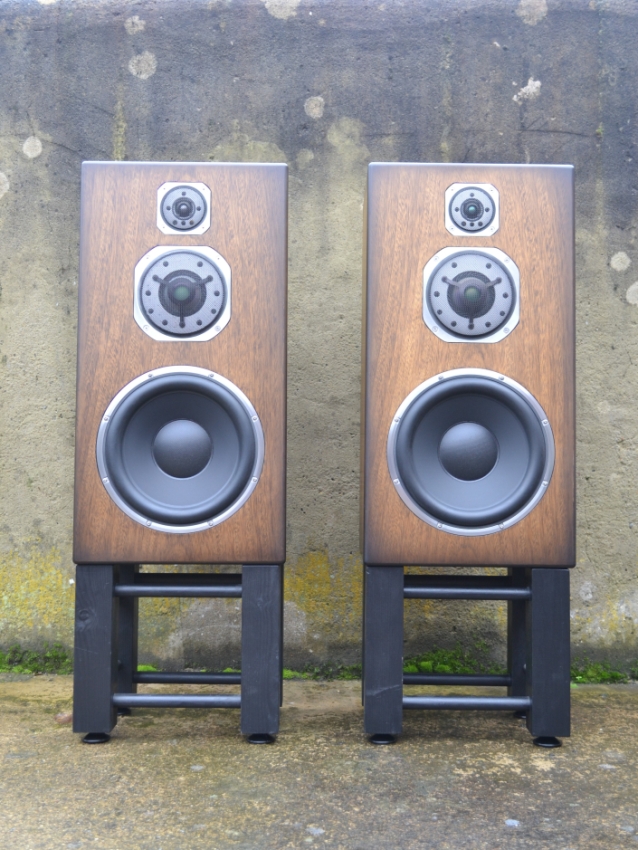 Final Tweaks Bass Drivers
I stripped the paint off the rims and sanded the rough cast finish to be smooth and blemish free, then finished it with Scotchbrite plastic abrasive. This gave a sort of brushed finish, to match the Midrange and Tweeter. Speaker Cable I didn't use anything exotic....... For HF, Atlas Hyper 2.0 between the Power Amp and the cabinet terminals. Internally I used the same from the binding posts to the passive x-over, then from the x-over to the Mid/Twtr drivers, I used the thinner Hyper 1.5 For LF, I used Van Damme 6mm sq HiFi cable, from Amp to cabinets, then internally 2.5mm sq of the same, from the input terminals to the Bass driver. Active eXO
Level Matching Controls. I removed the pair of (L/R) trim pots from the Marchand PCB and replaced these with high quality off board stepped attenuators. But after simplifying the circuit and removing the balanced output board, the gain chain of my HF/LF paths created identical output at the drivers, so no attenuation was needed, to match the output levels. Output Caps. The Sparko's discrete op amps I used on the balanced output board created a severe switching thump through the bass drivers, when turning my Nord Amp on/off. In an attempt to reduce this, I fitted some AuricapXO 1.5uF caps in series with the X-Over outputs. This didn't completely eliminate the noise, but it brought it down considerably, to a level I felt comfortable with, more of a soft click, than a loud thump. When the design was simplified and the balanced converter board was removed, there was no need for the output caps, so this was another dead end, of which their had bee many. Many, many variants were tried, this is what the active crossover looked like at the height of its complexity. 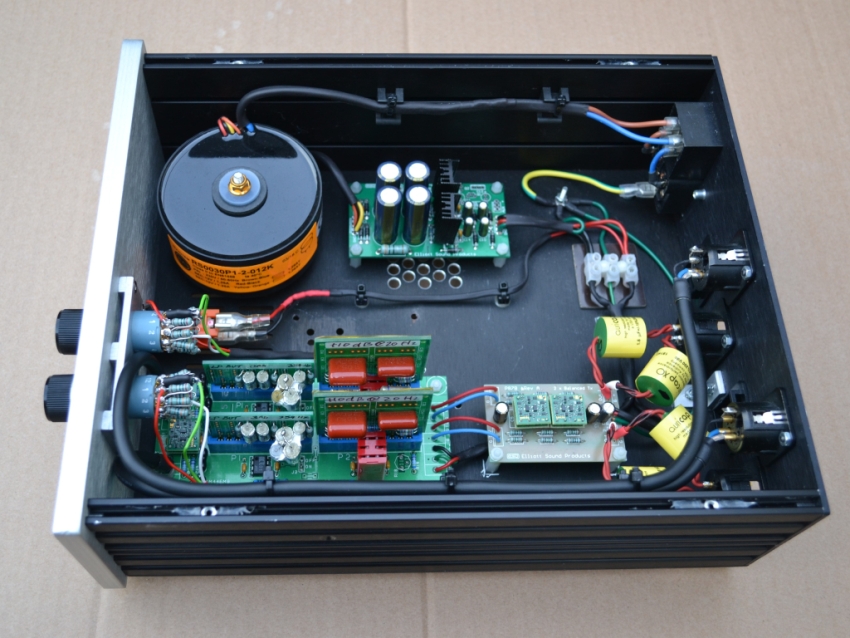 And this is what it looks like in its final simplified form. 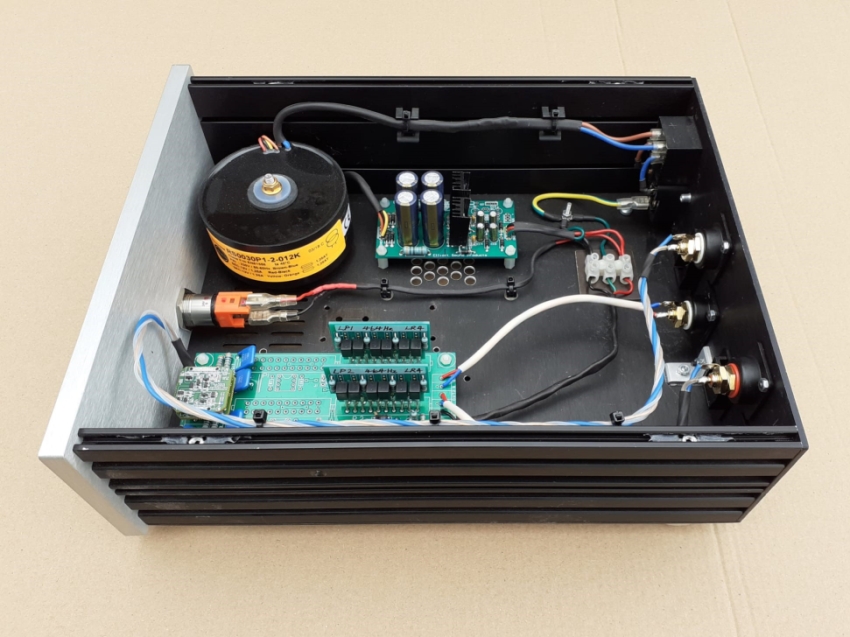 This simplified circuit is Single Ended throughout and uses high quality parts. There's just a pair of LR4 LP filters operating at 464Hz, it sounds so much better than anything else I tried. The op amp combination I used makes a big contribution toward this. Bass Driver Performance Here is the all important comparison of the bass produced by the "Upgrade" Speakers v stock NS-1000M 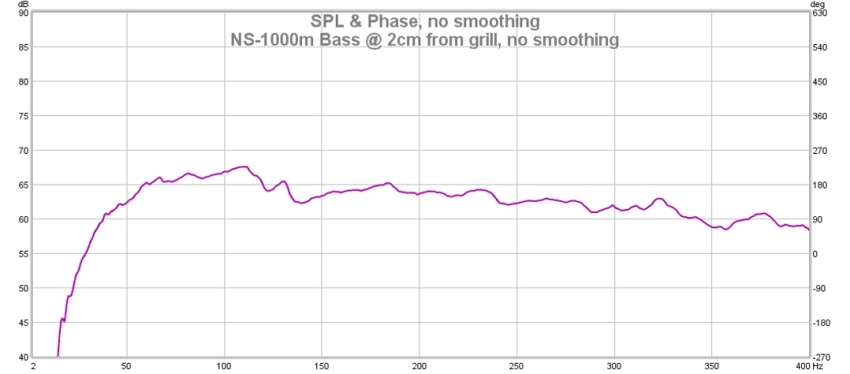 The original Yamaha NS-1000M Bass driver, measured near field in its 50L sealed cabinet. It’s not a flat response, tilting down 6dB as frequency rises. It has a peak at 110Hz then slowly rolls off and quite steeply from about 65Hz, producing little below 50Hz. This measurement has been verified by many people, including Troels Grevesen and also reflects what Yamaha published in the product brochure (see below). The mid bass peak is what gives the impression of more bass than there actually is. 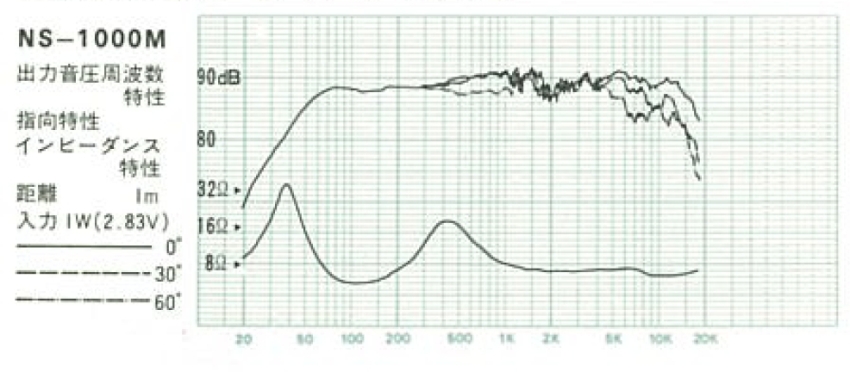 This is the full speaker response that Yamaha published in their Brochure for the NS-1000/NS-1000M The 40Hz - 20KHz response they promoted, is clearly based on the f6 points, not the f3. According to this, the true f3 +/- 3dB response is closer to 52Hz -17KHz. The falling response of the bass driver, as frequency rises, is supplemented by the mid ranges contribution, to end up more or less flat. The NS-1000m really is all about the excellent mid driver, which extends well into Bass and Tweeter territory, to help prop up both those drivers responses.  Near field measurement of the replacement Scanspeak Bass driver, mounted in its 55L sealed cabinet, this is a far superior response, with f3 around 33Hz. Note the Marchand LP filter is in use at 500Hz, the final version was set at 464Hz.. If you want to see the passive midrange and tweeter response, check out Troels measurements on his site, the last two plots towards the bottom of the page show the in room response. Bear in mind, he used the Yamaha bass driver. http://www.troelsgravesen.dk/Yamaha-NS1000.htm So what do the new speakers sound like, compared to the original NS-1000M? First let me dismiss any notion that the Scanspeak bass driver is in any way inferior. It doesn't just go deep, it's tuneful, well controlled and has good timber, equal to, if not better than the original and is in no way muddy. It has massive x-max and can go very loud without any sign of strain or losing its way. Dynamic is an understatement. It's not just about the bass though, the midrange and top end has also improved. By using Troels passive elements, which include notch filters, the response is flatter and has a bit of welcome body and warmth. Not too coloured though, you can still tell its origin was as a studio monitor. The Mundorf Supreme and Silver in Oil caps, give a very balanced and neutral presentation, the later works very well with the Beryllium Tweeter giving a clear and crisp top end. Compared to the stock speakers, the top end is less ragged and virtually sibilance free. The midrange has more body and texture to it, yet retains the famed razor sharp imaging. The bass is just in a different league, beyond comparison, now having true depth with refinement. These modified speakers also seem less Amp fussy, there are far fewer tracks that make you cringe, the original NS-1000M takes no prisoners and is ruthless to a fault when given poor material, the "Upgrade" is a little more forgiving. If Yamaha were to produce a modern equivalent of the NS-1000M, I'd like to think it would have some of the traits displayed by these Speakers. So, the overall effect has been to reign in the slightly forward upper frequencies, add a little body to the mids and provide a bottom end that would satisfy most people. All the things I found slightly lacking in the original speaker and would change if I could, have been addressed. Its taken me over 5 years to get to this point, where I feel content with the results. I finally have a set up that matches my personal take, on what a good speaker should sound like, I can't see me ever changing from these. As said early on, it functions as a complete set up, with Amps, Active/Passive X-Overs and drivers, all contributing to the overall performance. Apart from the bass, the improvements are subtle, as there was not a lot wrong with the original. The sound and look of the new speakers are very definitely in keeping with the original Yamaha NS-X000 family.  A modern take on the Yamaha NS-1000m Frequency response: f3 of 33Hz - 17KHz I am very, very, happy with the results, these are my keepers! |
 |
 |